











Publishing in the AI Search Era: How Publishers Can Adapt to Google's AI Overviews, ChatGPT & the New Discovery Landscape
Artificial intelligence has permanently reshaped the way audiences discover content. From Google’s AI Overviews to conversational platforms like ChatGPT, Perplexity, and Claude, traditional search is evolving into a more summarized, conversational, and zero-click experience.
For publishers, this shift is profound. Click-through rates on top-ranking Google results have fallen by as much as 40%, while zero-click searches now account for nearly 70% of news queries. At the same time, AI search platforms are introducing new opportunities — from licensing deals to retail-driven referral traffic — that publishers can no longer ignore.
This article provides a publisher-focused deep dive into AI search: what’s changing, what the data says, and how to adapt strategies for survival and growth in this disrupted landscape.
Table of contents- 01 Introduction: Why AI in Search Matters to Publishers
- 06 Retailers and AI Referrals: A Model for Publishers?
- 02 Google vs. AI Competitors
- 07 From SEO to GEO: Generative Engine Optimization
- 03 Traffic Shifts and Click-Through Rates
- 08 How Publishers Can Optimize for AI Search
- 04Consumer Behavior in AI Search
- 09 FAQs
- 05 Publisher Challenges: Attribution, Revenue & Regulation
- 10 Conclusion
Introduction: Why AI in Search Matters to Publishers
Search has always been the backbone of digital publishing. For many outlets, Google referrals account for 20% or more of total traffic. But with AI-driven summaries increasingly answering questions at the top of search results, that model is under pressure.
AI is not a “future” trend — it’s here today.
More than 75% of people now use AI search tools more than they did a year ago. Google, with 16.5 billion monthly visits, still dominates, but challengers like ChatGPT and Claude are growing. AI search has already caused click-through rates on top Google positions to fall by as much as 40%.
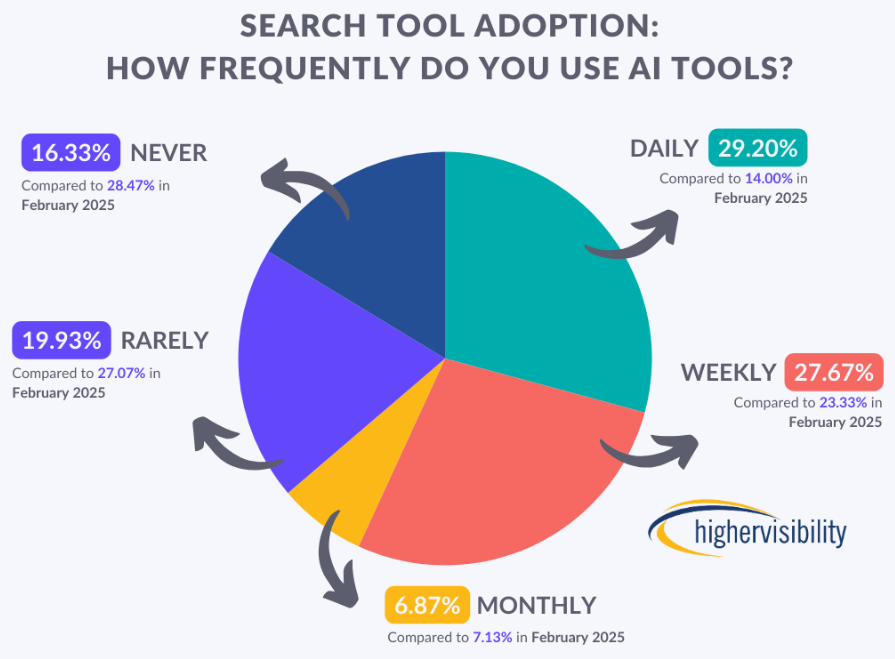
(Source: HigherVisibility)
The shift affects everyone:
- Publishers risk losing traffic due to zero-click answers
- Marketers must adapt SEO strategies for AI summaries
- Retailers are gaining valuable traffic from AI-driven shopping tools
According to Similarweb, zero-click news searches rose from 56% in 2024 to nearly 69% in 2025. Organic traffic to publishers fell from 2.4 billion visits to 1.77 billion in just 18 months.
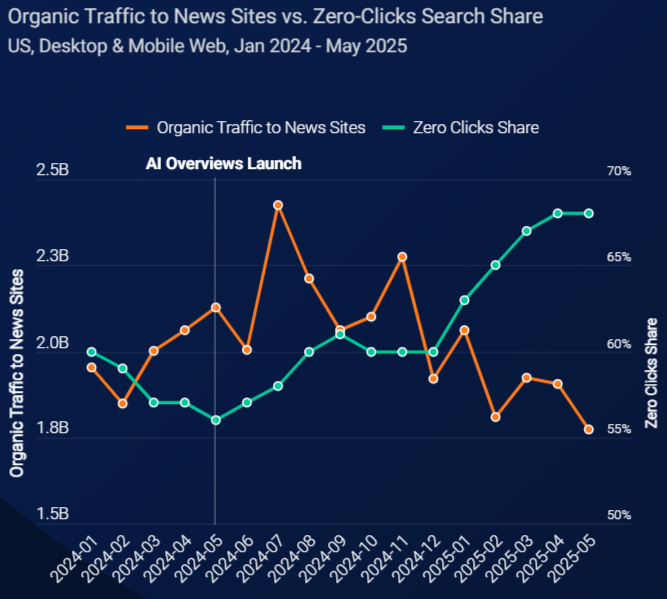
(Source: Similarweb)
It’s not just about increased use, either; it’s a matter of preference, with more than half prefer AI for summarized, direct answers.
For publishers, the implications are clear: AI search is no longer optional background noise. It is a primary channel shaping how audiences discover content — and how much of that content translates into traffic, subscriptions, and revenue.
Google vs. AI Competitors
Google remains the leader — 30× larger than ChatGPT in search traffic. less than a year ago. Its AI Overviews are central to keeping users in Google’s ecosystem, answering more complex searches and long-tail queries directly.
Google insists AIOs increase click quality and highlight sources, but multiple independent studies show otherwise: CTR for Position #1 dropped by 34.5% where an AI Overview is present.
Not only that, but competition is intensifying:
- ChatGPT usage tripled between February and August 2025, rising from 4.1% to 12.5% of search share.
- Platforms like Perplexity and Claude are gaining traction as trusted Q&A alternatives.
- Specialized AI agents (Salesforce, Cohere, Microsoft) are fragmenting enterprise adoption and competing for workflow dominance.
- Voice and visual search are on the rise, reshaping Google’s own design.

(Source: Muck Rack)
For publishers, this fragmentation means audiences aren’t just searching in one place anymore. Discovery is moving across multiple AI-powered environments, each with its own rules for inclusion.
Traffic Shifts and Click-Through Rates
Publishers and marketers are seeing clear shifts:
- CTR declines: Position #1 in Google dropped from 28% to 19% CTR in one year.
- Zero-click rise: 43% of marketers report changing strategies because users get answers without clicking.
- Stable overall traffic: Chartbeat found search referrals steady at ~19% of traffic, in July, largely because of Google Discover.
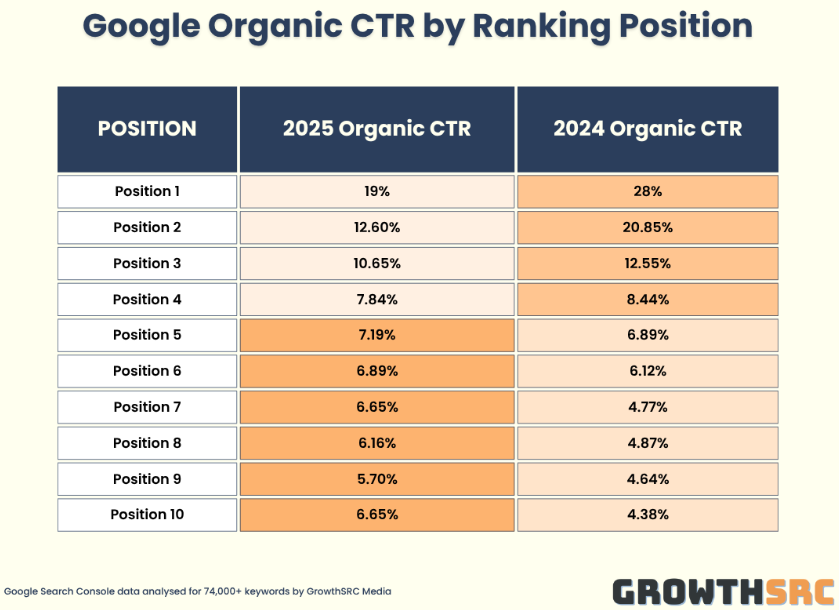
(Source: GrowthSRC)
For publishers, visibility in AI Overviews creates a paradox: visibility does not equal traffic.
Consumer Behavior in AI Search
Understanding user behavior is critical for publishers adapting to AI search.
And right now, consumers are rapidly embracing AI search tools:
- 53% prefer AI for direct, summarized answers, according to Yext. 42% use AI for creative help, 41% for deeper, nuanced responses.
- 43% trust AI search results as much as organic search, and 41% even trust them more than paid search.
- 60% expect to increase their use of AI search in the next 6 months, according to Attest research earlier this year.
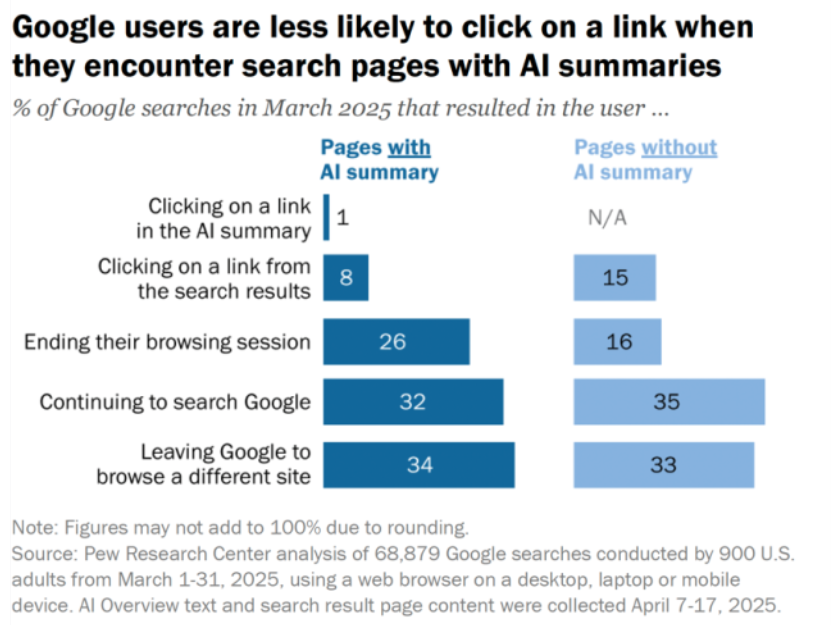
(Source: Pew Research Center)
However, concerns remain:
- 58% worry about personal data in AI’s hands.
- Two-thirds of consumers don’t want AI making purchases for them, according to Omnisend.
For publishers, this behavior shift means audiences are still searching — but often consuming answers directly on AI platforms without ever clicking through.
Publisher Challenges: Attribution, Revenue & Regulation
Publishers face an existential threat from AI Overviews, as content is scraped, summarized, and shown with little attribution. This year, UK publishers filed an antitrust complaint arguing Google’s AI summaries harm traffic and revenue. Meanwhile, U.S. publishers such as The New York Times and Washington Post launched campaigns to "make Big Tech pay” for content.
The biggest pain point for publishers is loss of attribution and monetization, as AI Overviews summarize publisher content without adequate credit or subsequent traffic.
Revenue shifts:
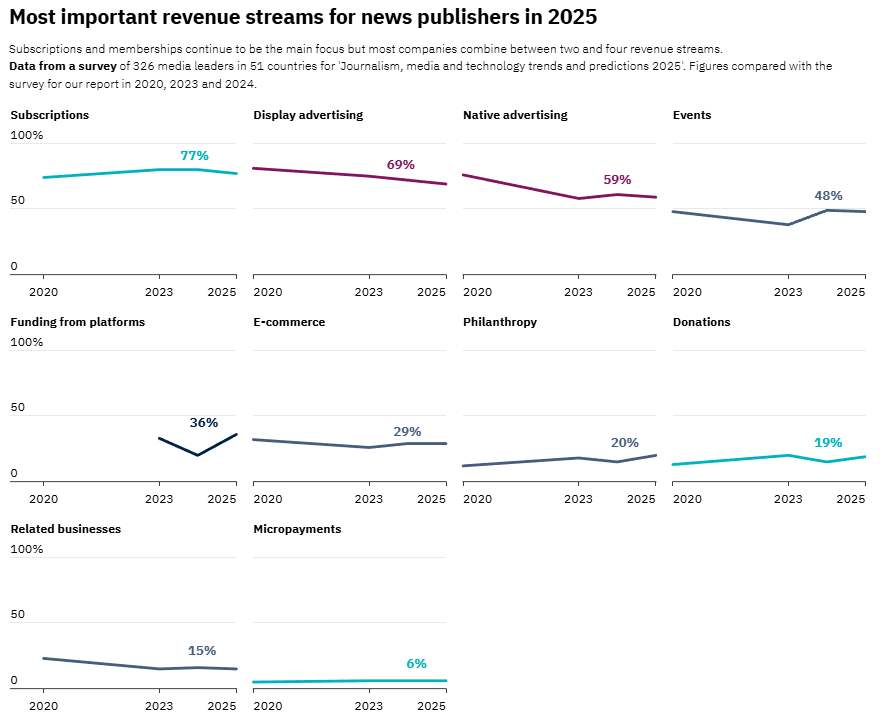
- 36% of publishers expect AI licensing fees to be a major revenue stream this year
- Subscriptions (77%) and advertising remain critical, but AI licensing is rising
(Source: Reuters Institute for the Study of Journalism)
However, concerns remain:
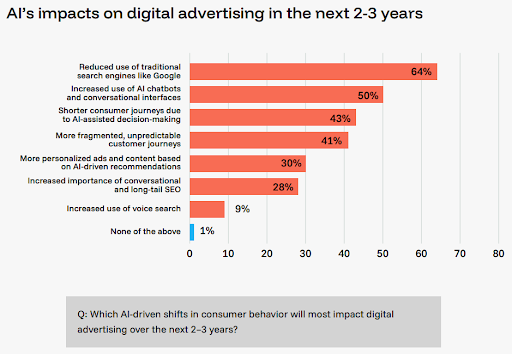
- 50% predict increased use of AI chatbots
- 43% predict a shorter customer journey thanks to AI-assistance in making decisions
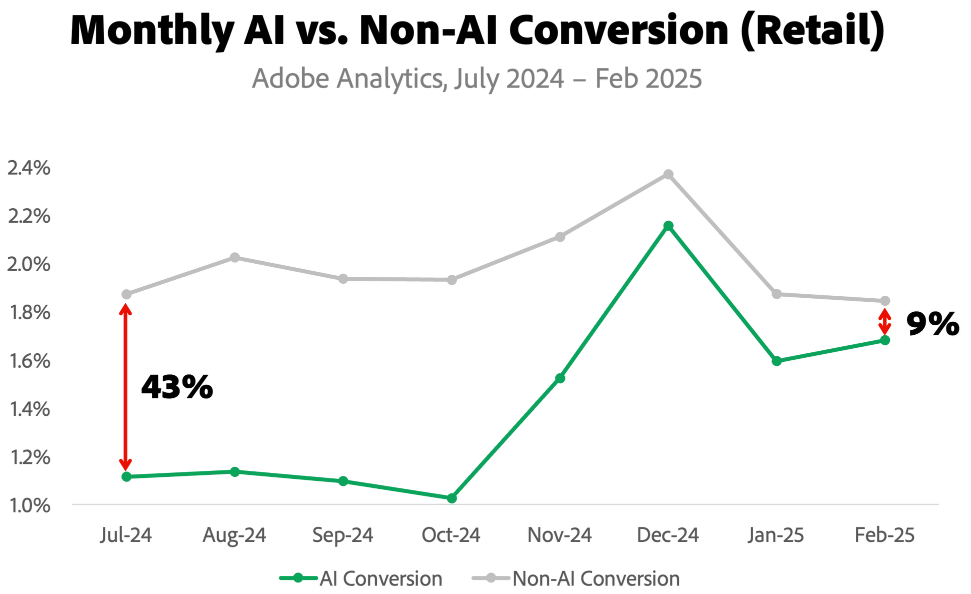
- Adobe tracked a 1,300% YoY surge in AI-driven traffic to U.S. retail sites during last year’s holiday season.
- AI referrals show 8% higher engagement, 12% more pages per visit, and 23% lower bounce rates than traditional traffic.
- Conversion rates remain lower (–9%), but the gap is narrowing.
- Research (55%)
- Recommendations (47%)
- Finding deals (43%)
- Gift ideas and product discovery (35%)
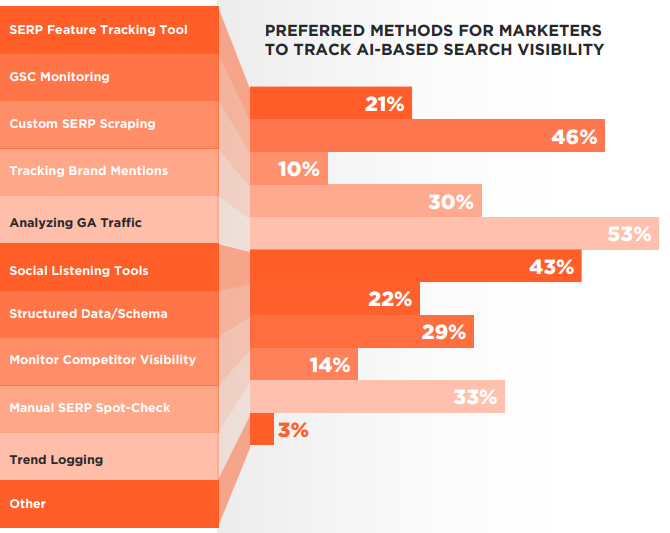
- Frequent content refreshes (58% of marketers are doing this)
- Schema markup (54%)
- Analyzing AI-driven traffic shifts (42%)
- 56% report increased traffic since AI Overviews launched
- 48% report revenue boosts from ads and affiliate links
- Adapting SEO into GEO
- Structuring content for AI summaries
- Building trust with consumers
- Leveraging AI-driven retail and ad opportunities
As for digital advertising, 64% of marketers are predicting their customers will reduce their use of traditional search engines over the next few years.
Additionally, according to the Funnel research:
Retailers and AI Referrals: A Model for Publishers?
While publishers are struggling, retailers are seeing huge gains from AI search.
(Source: Adobe)
Consumer uses of AI in shopping:
For publishers, the lesson is that AI can drive high-quality referrals when aligned with user intent. If retailers can optimize for AI-driven recommendations, publishers may be able to do the same by targeting topical authority and structured data that AI assistants prefer.
From SEO to GEO: Generative Engine Optimization
Traditional SEO is evolving into Generative Engine Optimization (GEO) — the art of getting cited, summarized, and recommended inside AI systems.
Key tactics, according to NP Digital, include:
(Source: NP Digital)
And contrary to many doomsday predictions, marketers are seeing positive signs:
Publisher takeaway: AI Overviews aren’t killing visibility — they’re changing the rules of visibility.
How Publishers Can Optimize for AI Search
As search behavior evolves, so too does the framework for GEO optimization.
Audit AI visibility
Track keywords + AI-trigger report
Structure content for summaries
Use FAQ-style H2s, direct one-sentence answers, and schema markup.
Prioritize conversational tone and bullet-point lists that AI can easily extract.
Refresh frequently
Update statistics, add new examples, and keep content current — freshness signals help AI selection.
Build AI citations
Pursue partnerships and licensing deals with ChatGPT, Perplexity, and Google for inclusion
Balance trust & creativity
Highlight brand authority and transparent sourcing.
Use clear attributions, bylines, and citations — signals AI looks for when choosing reliable sources.
Frequently Asked Questions
1: Will AI search replace Google?
Not yet — Google is still massively larger than any AI model, but those tools are eroding Google’s dominance.
2: How should SEO adapt to AI Overviews?
Focus on direct answers, schema markup, brand mentions, and conversational content.
3: Do people trust AI search results?
Yes — and that number is sure to grow as AI’s abilities improve. Currently 43% trust them as much as organic search, and 41% more than paid ads.
4: Will AI kill publisher traffic?
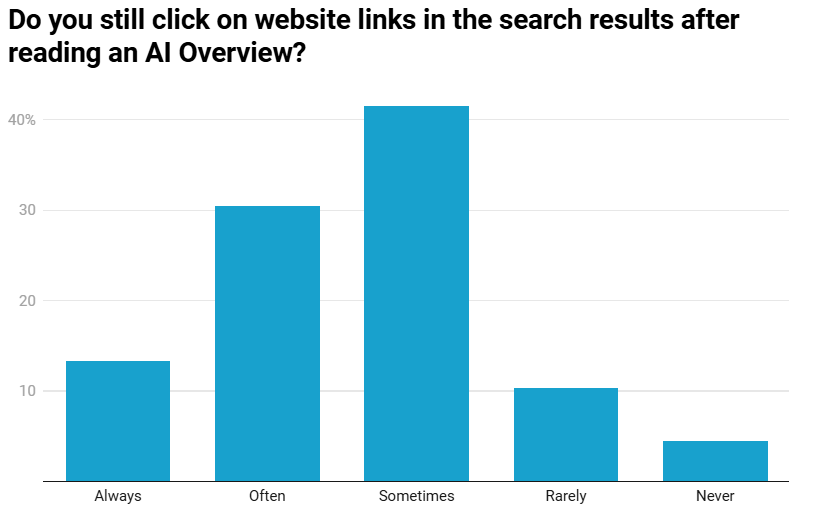
Not entirely. Some studies show traffic remains stable, but distribution and revenue models are shifting
(Source: NP Digital, via Press Gazette)
5: Should publishers block bots?
It varies by publisher size, with larger publishers more likely to feel the traffic effects of blocking bots and, subsequently, losing humans through AI-powered search. As the researchers behind “The Impact of LLMs on Online News Consumption and Production” paper found, “blocking genAI bots can have adverse effects on large publishers by reducing total website traffic by 23% and real consumer traffic by 14% compared to not blocking.”
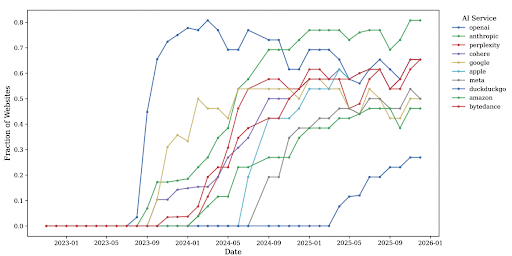
Fraction of sites that disallow genAI bots (Source: "The Impact of LLMs on Online News Consumption and Production")
Conclusion`
AI is transforming search into a conversation-driven, answer-first ecosystem. Google remains dominant, but challengers and consumer behavior shifts are forcing marketers, publishers, and retailers to rethink discovery, attribution, and optimization.
As threatened as publishers might feel, AI search is also an opportunity.
That opportunity? Visibility in AI-driven answers, new licensing revenue, and stronger brand authority if optimized correctly.
Success in the AI search era means:
The future of publishing won’t be decided by whether AI search exists — it already does. The real question is whether publishers will adapt their strategies from SEO to GEO, ensuring their journalism and content remain discoverable, trusted, and monetized in an AI-first discovery ecosystem.
The rules of search have changed — and those who adapt now will lead in the AI-powered discovery economy.